Our Go-To Minimalist Gear for Winter Cabin Life
Stepping outside the cabin this time of year, the air hits you. It’s not a sharp, painful cold; it’s a deep, cleansing stillness.
There is a unique and special calm to life in a cabin during the winter months.
When we moved here, trading the fast-paced grind of city life for the slower, simpler lifestyle of the cabin, we expected to face winter with an arsenal of specialized gear.
After all, isn’t that what every outdoor retailer tells us we need? The truth is that mindset actually leads to clutter, waste, and confusion.
We quickly realized that true warmth in a simple life isn’t about accumulating more; it’s about intentionality.
Living in a wood-heated home has taught us the most significant lesson in winter minimalism: only the multi-functional, durable, and truly necessary items deserve a place in our lives.
This post cuts through the marketing fluff to share the exact, minimal winter gear we use daily to work, live, and thrive in the cabin.
Plus, we’re exposing the costly gear that turned out to be nothing but a waste of money (we’re spilling all the tea).

The Importance of Layering
When your primary heating is a wood stove, the temperature can swing wildly. It can be scorching hot near the stove and chilly just one room over.
You need a system that adapts, not a single bulky coat or sweatshirt.
This is the layering principle, a common approach used by those who enjoy outdoor sports and adventures.
Instead of owning half a dozen different sweaters and jackets for each potential temperature, we rely on three core pieces that can work together or individually to adjust to our needs.
A key rule when dressing for cabin life: Avoid cotton.
Cotton holds moisture, and that moisture can make you dangerously cold when you step outside or work up a sweat hauling wood.
Instead, we do our best to stick to natural fibers and high-performance synthetics.
Base Layer
The base layer is arguably the most critical piece of winter gear. It’s the layer worn against your skin, and its job is to manage moisture (sweat) while trapping body heat.
In our cabin, we wear this layer almost non-stop as our primary “indoor outfit.”
Merino wool is a great option as it’s soft, incredibly warm, and possesses natural anti-microbial properties.
I recommend the brand Merino Protect. They offer 100% merino wool t-shirts and leggings.
Mid Layer
The mid layer is your insulation layer, trapping air warmed by your body to help keep your core temperature stable.
Because we are constantly moving (chopping wood, shoveling snow, walking the dogs), we prioritize clothing that offers warmth without restricting our movement.
For this, I prefer a simple fleece zip-up sweater, such as the Columbia Benton Springs Full Zip.
This easily slips on over the base layer, ensuring we don’t shed heat too quickly during active chores. At the same time, it’s not too heavy that it causes us to sweat.
Outer Layer
Many people make the mistake of buying a heavy, insulated coat. That’s a waste of money if you have good layers underneath!
The job of the outer layer isn’t to make you warm; it’s to protect your already-warm layers from the elements.
Rather than purchasing a winter jacket, an ideal outer layer would be a simple, waterproof/windproof, lightweight shell jacket.
My favourite is the Columbia Women’s Arcadia II Jacket.
When paired with your existing layers, the shell stops wind, ice, and wet snow, keeping you warm and protected without adding unnecessary bulk.
Protecting Your Extremities
The hands, feet, and head are crucial parts to consider when trying to regulate your body temperature.
Failing to protect these extremities is not only uncomfortable but also dangerous in extreme cold.
For the minimalist cabin dweller, this means investing in high-quality items for each function, eliminating the need for duplicates while keeping yourself safe.
One truly excellent pair of boots is a much better investment and far more sustainable than three mediocre pairs.
Footwear (Outdoor vs. Indoor)
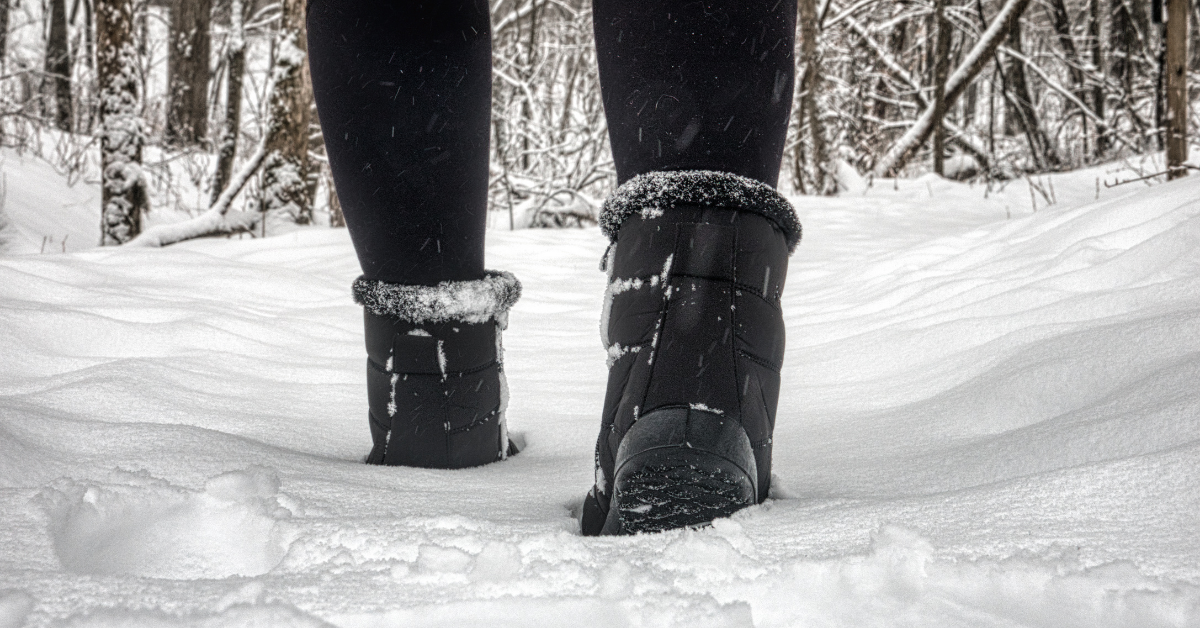
Our outdoor footwear must be rugged enough to handle daily chores like splitting wood or walking to the mailbox, and warm enough to protect our feet against deep snow and ice.
I recently purchased a new pair of boots, focusing on a high-quality, fully insulated, waterproof pair (rated to -40C).
After careful research, I purchased Kamik Momentum 3 Winter Boots.
They are my “everything boots” during the winter months, handling axe work and firewood hauling, deep-snow walks, and constant exposure to ice and water without fail.
When moving indoors, footwear is still an important consideration.
A wood stove heats the air, but the floor (especially in an older cabin) remains stubbornly cold.
In addition to warm wool socks, I recommend a simple, sturdy slipper with a non-slip rubber sole.
I was gifted a pair of microsuede slippers from EverFoams that have been keeping me warm and cozy even on the coldest mornings.
Head & Hands
Gloves and hats often become the biggest source of clutter in many homes, especially up here in snowy Canada.
We used to have a drawer full of mismatched winter gear that we would dig through to find something each time we got ready to go outside.
Now, we have taken a more minimal approach, focusing on one high-quality item per function.
I have always found that traditional gloves lack the necessary warmth (or are super bulky). At the same time, mittens make more complex tasks (like strapping on snowshoes or opening puppy poop bags) impossible.
The convertible mitten/glove offers the best of both worlds: the warmth of a mitten (fingers together) with the ability to flip the top back to expose your fingertips when needed.
My KastKing ThermoGrip Convertible Gloves were designed for outdoor adventures like ice fishing and hiking, keeping me comfortable in any weather.
As for a hat, I recommend a simple, merino wool toque.
This is a warm, breathable option that you can wear indoors if the fire is low or outdoors in the bitter cold. It also easily stuffs into a jacket pocket if you need to remove it.
The Waste Pile
Minimalism isn’t just about what you keep and invest in; it’s about carefully eliminating anything you don’t need.
We admit, early on, we wasted money and space on items that simply didn’t stand up to the practical demands of life in a wood-heated cabin.
Here are some of the items we purchased, found that they didn’t work, and have since purged from our gear, along with the sustainable, simple alternatives that we prefer:
|
The Wasteful Buy |
Why It Was a Waste in the Cabin |
Minimalist Alternative |
|---|---|---|
|
Puffy, down-insulated parka |
Too hot for active work and too bulky for storage. Once we started moving, we overheated immediately and had to take it off, leaving us unprotected. |
The 3-layer system I outlined above is far more adaptable. You can take the shell off during active chores if needed, while still maintaining warmth with the insulated layers below. |
|
“Fashion” winter scarf or knit cowl |
Constantly dangling, getting wet, snagged on branches, or getting too close to the hot stove. They are often difficult to wash and slow to dry. |
Instead, opt for a simple, stretchy merino wool neck gater (or buff). It stays securely in place, fits under your shell jacket, is easy to wash, and dries quickly. |
|
Electric boot dryer |
An unnecessary appliance. It relies on electricity (which we try to conserve) and is relatively slow. We used one a few times and realized it was redundant and taking up space. |
We dry our boots, slippers, and socks on a metal drying rack positioned beside the wood stove. The residual heat from the fire is fast, free, and very effective. |
|
Single-use hand/toe warmers |
A disposable, single-use product that creates trash and requires constant repurchasing. This conflicts directly with our sustainability goals. |
Using a high-quality pair of convertible mittens (which are inherently warmer than gloves) effectively keeps hands warm over an extended period. |
|
Five pairs of random winter gloves |
A drawer full of different weights and materials. They never offered enough warmth, often wore out quickly, and usually became wet and frozen after outdoor use. |
The single pair of convertible mittens will provide better warmth and protection while saving space and money. |
The Takeaway: When gear is simple, multi-functional, and high-quality, it stops being a collection of random “things” and starts becoming part of a sustainable, self-sufficient system.
We learned that if a piece of gear doesn’t directly contribute to warmth, safety, or efficiency in our lives, it’s just clutter.
Warmth Thought Minimalism
The biggest realization we’ve had since moving to the cabin is that true warmth and comfort are about intention, not consumption.
We used to believe that preparing for winter meant buying the newest gadgets or specialized items for every imaginable weather condition.
Now, we focus on our carefully selected minimalist winter gear.
This approach frees up money, space, and most importantly, our mental energy. We no longer manage a constant flow of gear; we are focused on being in the moment.
When you invest in quality and functionality, you invest in a lifestyle that is sustainable and truly satisfying.
What is one winter item in your closet that serves only one purpose, is rarely used, or causes clutter? Take a moment this week to identify it and let it go.